
HMO Room Design That Commands £475/Month: The Complete Setup Guide
Why Most HMO Rooms Leave £100+ Per Month on the Table
Most landlords furnish HMO rooms the same way: a flat-pack bed, a cheap mattress, a wardrobe from the nearest budget store, and magnolia walls. Job done. Room let.
Except it's not done. Not if you're targeting professional sharers — the demographic that actually pays £425–£475/month without complaint and stays for 18 months rather than six.
According to research cited by the August App (a professional HMO management platform), professional tenants rank quality of furnishings and room finish in their top three decision factors — alongside location and broadband speed. A badly staged room doesn't just look worse in photos. It attracts a different tenant profile: one who haggles on price, leaves faster, and costs you more in voids.
Kenny Pitman, who documents his rent-to-rent HMO portfolio on YouTube, makes this point bluntly: spending £500–£1,000 on the right items — feature walls, bedding sets, lamps, rugs, wall art — transforms a room's perceived value faster than almost any structural change. I agree with him. And I'd go further: the ROI on that spend, measured in additional monthly rent, is almost always better than the ROI on a new kitchen.
The £500 Shopping List That Actually Works
Here's what I'd spend — and what I'd skip.
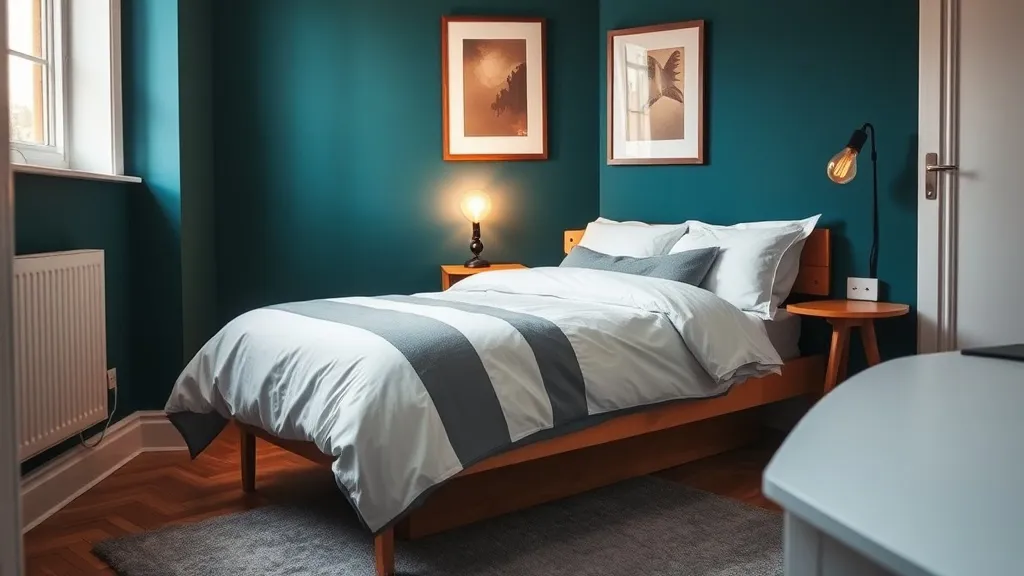
Feature wall paint: £25–£35. One wall, deep colour — Forest green, slate blue, or charcoal. Not all four walls. One. It photographs dramatically and costs almost nothing. Dulux or Farrow & Ball dupes from B&Q do the job at a fraction of the price.
Bedding kit: £60–£80. The Range sells hotel-style duvet sets — white base, grey or navy accent — that photograph like a boutique hotel. Wash them twice before the room goes live. Crisp bedding is the single highest-impact visual element in any listing photo.
Bedside lamp: £20–£35. Warm Edison bulb, not an LED strip. Overhead lighting makes rooms look like a budget hostel. A bedside lamp with a 2700K bulb makes the same room look like a Shoreditch Airbnb.
Desk lamp: £15–£25. Professional sharers work from their rooms. A proper desk lamp signals that you understand their lifestyle. It costs £20.
Wall art: £30–£60 for two or three framed prints. The Range, IKEA, or even Etsy digital downloads printed at Snappy Snaps. Abstract, botanical, or architectural prints in neutral tones. Nothing generic, nothing corporate.
Rug: £40–£70. Covers cheap flooring, adds warmth, reduces noise. A 120x170cm rug from The Range or Dunelm transforms a room acoustically and visually.
Blackout curtains or blinds: £30–£50. This is non-negotiable for professional tenants who work shifts or travel. Poor sleep quality is a tenancy-ending issue.
Total: £220–£355. That leaves you £145–£280 of your £500 budget for a full-length mirror (£30–£50), a small bedside table if one isn't there (£25–£40), and a USB charging hub built into the bedside lamp or desk (£15–£25). Every item earns its place.
What I'd skip: decorative cushions that tenants remove immediately, artificial plants that gather dust, and any artwork with text or inspirational quotes. They read as cheap. They are cheap.
The Ensuite Calculation: £5,000–£8,000 In, £100–£150/Month Extra Out
If your budget stretches beyond £500, the single highest-return structural upgrade in an HMO is an ensuite.
Quartico's landlord guide puts ensuite installation at £5,000–£8,000 depending on whether you're tapping into existing plumbing or running new pipes. August App's research shows ensuite rooms command a £100–£150/month premium over identical non-ensuite rooms in the same property.
Do that maths. At £125/month premium, the payback period on an £8,000 ensuite is 64 months — just over five years. On a £5,000 installation hitting £150/month extra, it's 33 months. And that premium compounds: when you refinance or remortgage, higher rental income supports a higher valuation.
I'd prioritise an ensuite over a new kitchen every single time in an HMO context. Tenants share kitchens. They don't share bathrooms — or they really don't want to. Privacy in the bathroom is the number one reason professional sharers pay a premium, and the number one reason they leave when they don't have it.
One trade-off worth naming: ensuite installation reduces room size. If your rooms are already at the HMO minimum (6.51 square metres for a single occupant under the Licensing of Houses in Multiple Occupation (Prescribed Description) (England) Order 2018), you may not have the space. Check your floor plan before commissioning anything.
Staging and Photography: The Step Most Landlords Skip
The room is designed. The room is furnished. Now photograph it badly and watch it sit empty for three weeks.
Professional staging with decent photography fills rooms faster. The HMOs Network, which manages HMO properties across England, notes that presentation quality directly affects void periods — and void periods are where landlords bleed money silently.
You don't need a professional photographer for every room. You need: a smartphone with portrait mode off, natural daylight (shoot between 10am and 2pm), the bedside lamp on, the overhead light off, and every surface cleared except the styled items. Shoot from the corner of the room, low angle, wide. That's it.
Pinterest-worthy photography isn't about equipment. It's about light, staging, and a room that actually has something worth photographing. Do the design work first. The photos follow.
And here's something most landlords ignore: the listing description. '7ft double bed, ensuite, high-speed WiFi, professional sharers welcome' outperforms 'double room available' in every A/B test I've seen referenced. Specificity attracts the tenant you want. Vagueness attracts everyone and converts no one.
The 77% figure from August App's research — that 77% of non-HMO tenants would consider shared living if the quality were right — tells you exactly where the market is heading. Quality HMO rooms aren't a niche product. They're the future of the mid-market rental sector. The landlords who figure out room design now, before it becomes standard, will hold the pricing power. The ones who don't will be competing on price alone. That's a race I wouldn't want to run.